
Some reflections on catastrophically snapping my humerus in half.
First, I’d just like to point out that whenever I set my mind to doing something, I do it to the absolute best of my ability. See X-ray for for one fine example of my work:
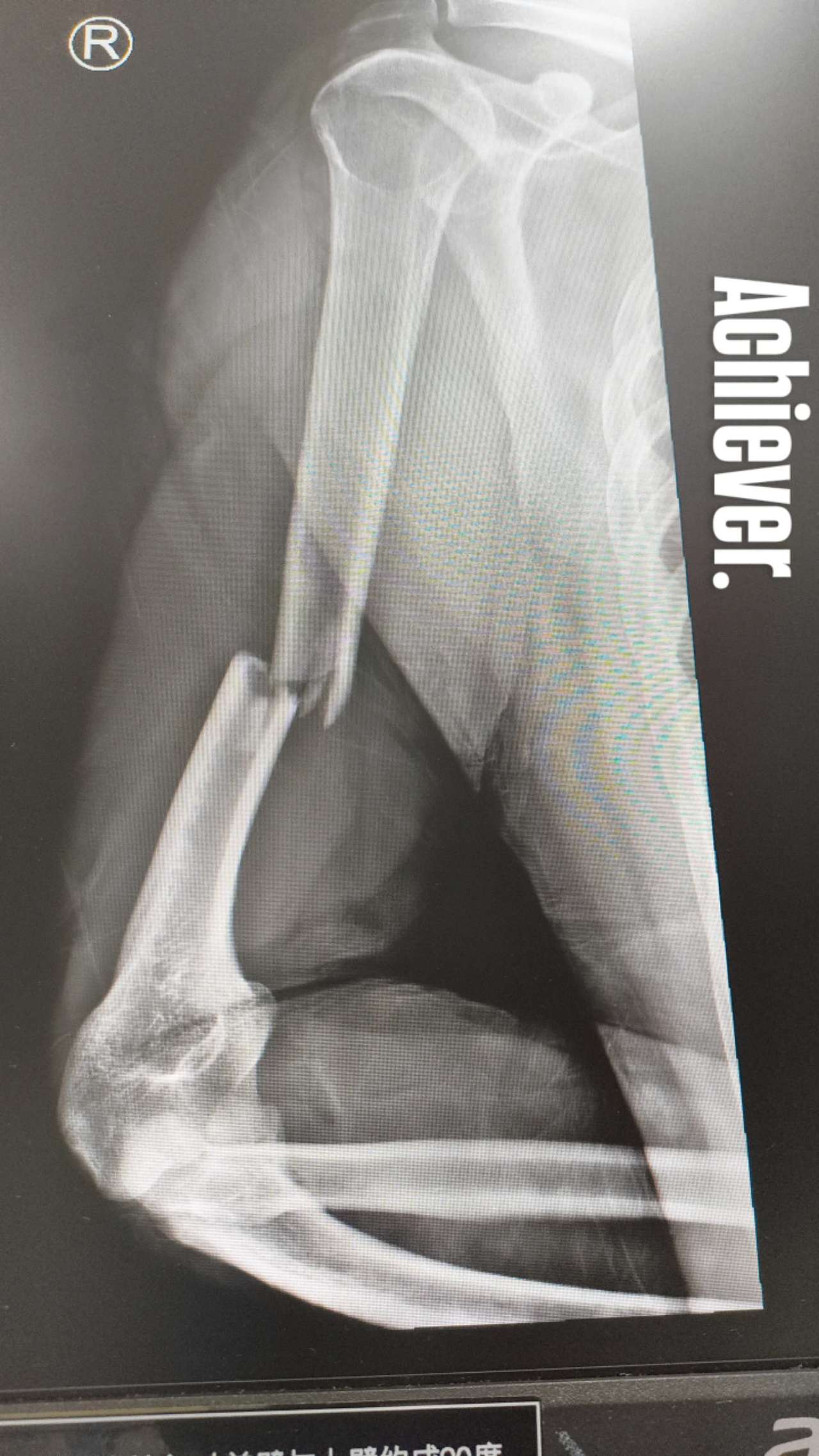
If this looks painful, it was. But probably not in the way you think it was painful. When I slipped, banana-peel style, on a muddy ramp and fell on my ass, I unfortunately caught myself with my right arm at a weird angle (I was wearing my backpack, too), causing what I think is called a “spiral fracture.” I immediately knew my arm was broken and, at that moment, I felt no pain, just the sickening discomfort of flaccidness from mid-humerus down. When you break your arm like this, you lose the structural integrity of the limb, which means your arm is only held together by soft tissue—bicep and my tricep—any force directed against holding the arm together is transferred from the bone to the ligaments and muscle tissue, which is a very strange, unsettling feeling indeed.
Within seconds, the ever-present, ever-watchful boyscout police (but not really) known as the Bao’an were present to help me up, though they did not fully understand how badly I was injured. In this moment I also did not feel pain. I felt a sense of urgency, resignation, and a profound desire to communicate clearly and immediately so as to resolve this situation, which is exactly what I did.
Within minutes the Bao’an had ordered me an ambulance, which, as best as I remembered it, arrived no more than ten or so minutes after I had slipped.
I arrived at the hospital and did not know which hospital or where I was exactly. As I learned the next morning, I was at the hospital I regularly go to for my check-ups, the venerable Hong Kong University Hospital of Shenzhen, a teaching hospital connected to Hong Kong University that is exceptional. However, I didn’t realize I was at HKU-SZ hospital when I arrived, and I didn’t particularly care which hospital was at, so long as they provided what I knew I needed: drugs. Drugs immediately. Drugs before my shocked system came to any sort of understanding of what I had done to the arm-part. These I asked for repeated.
Unfortunately, the extremely thorough nurses who attended to me immediately also insisted I get an X-ray, sign some forms (mind you: I broke my right arm, aka my writing arm), pay them 5,000 yuan, and recite various identification numbers, etc. At the time, though I do not remember feeling pain, I do remember having significant difficulty remembering numbers I have memorized by heart (like my passport number, my phone number). But we got through the bureaucracy. When they printed the X-ray (above), everyone was sufficiently convinced as I was that immediate drugs were in order.
I was wheeled on a gurney from the X-ray room to a bed in what I would later learn is the inpatient orthopaedic ward and I was given some sort of drug drip and I passed out.
A word on the pain: the pain I experienced was never worse than a bad bruise. Ever have shin-to-shin contact with someone while playing soccer? Yeah, that hurts. I never had pain worse than that. The real pain, however, wasn’t that sort of “bruising” pain. That pain is totally managable. I could tolerate that. The real pain came from the feeling of limpness. The flaccid arm. The noodling. The compromised (that’s an understatment) structural integrity. The dangling penduluous arm-flesh, cradled against your chest like a newborn baby. The sound of the two jagged halves of your humerus grinding and clicking against each other when you have to move—the sound hurts terribly, not like a bruise, but in a way that makes you feel sweaty and vomity and feverish.
Then the real bad news: I broke my arm on Sunday. There are no doctors on Sunday. I’d have to wait til Monday. The team of doctors and nurses and students would examine my arm on Monday, meet, plan the surgery, and then they’d humpty-dumpty me on Tuesday. So I had basically 2+ days to “hang out” (literally).
During these days I did a lot of gently shuffling around the hospital, making myself a nuisance to the staff out of boredom. The nurses at HKU-SZ Hospital worked with clocklike efficency: take your pill, time for ice, after lunch take this pill. When I woke up on Sunday, they walked me down the hall to get more X-rays.
Take of your shirt, the doctor said.
Either cut it off, or it stays, said I.
(They cut it off).
Change into hospital pants, the doctor said—another unthinkable task for me, as I was literally breaking heat sweat pain fevers in the middle of this exchange.
Did I break my leg? I asked.
You had better listen to the doctor if you want help, the doctor said.
You cannot fathom how much unnecessary pain I will suffer for your dress code, said I.
(The pants stayed on).
The doctors also have a special penchant for waiting until you are well-along into a drug-induced slumber to bust into your room and ask you a whirlwind of questions. The nurses too. But I’d be a damned liar if I said I wasn’t well-attended to by the team at HKU-SZ team.
One of the problems with breaking your arm in half is the unfortunate realization that almost everything you do involves moving your arm. It’s nearly impossible to move any part of your body without *slightly* moving your arm. Another strange feeling is that you can rotate your upper arm, from the ball and socket shoulder down to the break, but nothing below the break moves. So imagine this: I am laying in bed, on my back, my arm in a sling across across my chest. Physically, my lower arm is laying on my chest. However, because my upper humerus is actually rotated a different direction, my arm *feels* as if it are actually sticking straight up in the air. My brain interprets the position of my arm based on the rotation of my humerus, not the actual visual location of my arm. So I became three-armed: a left arm, a physical right arm-flesh, and a phantom right arm.
My roommates were quite interesting. There were three beds in our room. One bed was for a kid—I’m not sure what he was hospitalized for but his dad was with him the entire time. This kid had the unfortunate habit of playing on his phone without headphones, but if you’re a kid in a hospital you get infinite leeway from me. The bed next to me was occupied by an older gentleman who needed knee surgery. This guy must have done something right because every day about a dozen people would come visit him (I would take a walk to give them space). His daughter left me an entire meal at one point, which turned out to be a lifesaver because I woke up after surgery bleary-eyed, hungry, and the cafeteria had already closed. I showed my roomies my X-rays to shore up my bona fides (pun intended) for whining all the time.
Other fun things: they have a little park outside you can go walk around, or in my case, gingerly shuffle around delicately avoiding any motion that might elicit any sounds from my arm. The security guard and I developed a cordiality and he too was impressed when I showed him my X-rays at how successful I was at the task. The cafeteria at the hospital is quite excellent, and they had extra staff to carry my tray of food to the table. The first time I tried to open a bottle of tea I had to ask the octagenarian sitting next to me at the table to assist.
In the orthopaedic wing, I met one woman who had some sort of developmental issue with both her legs, and she was having novel surgery done to correct it, which would be medical research for the University Hospital. I told her that the doctors are as invested as she is in the success of this surgery: their careers depend on it. She agreed: if you have to go through something bad, at least you have the best circumstances. I hope her surgery went well.
The surgery happened Thursday afternoon and took under three hours. Before I went under, I patiently reminded my surgeons that it was the right arm that needs the business, and then I laid there humming the Wong Fei Hung themesong (lyrics / version by Jackie Chan / the best version of all) until the anaesthesia kicked in.
When I woke up I knew the surgery had been a success: structural integrity restored.
I dangle no more.
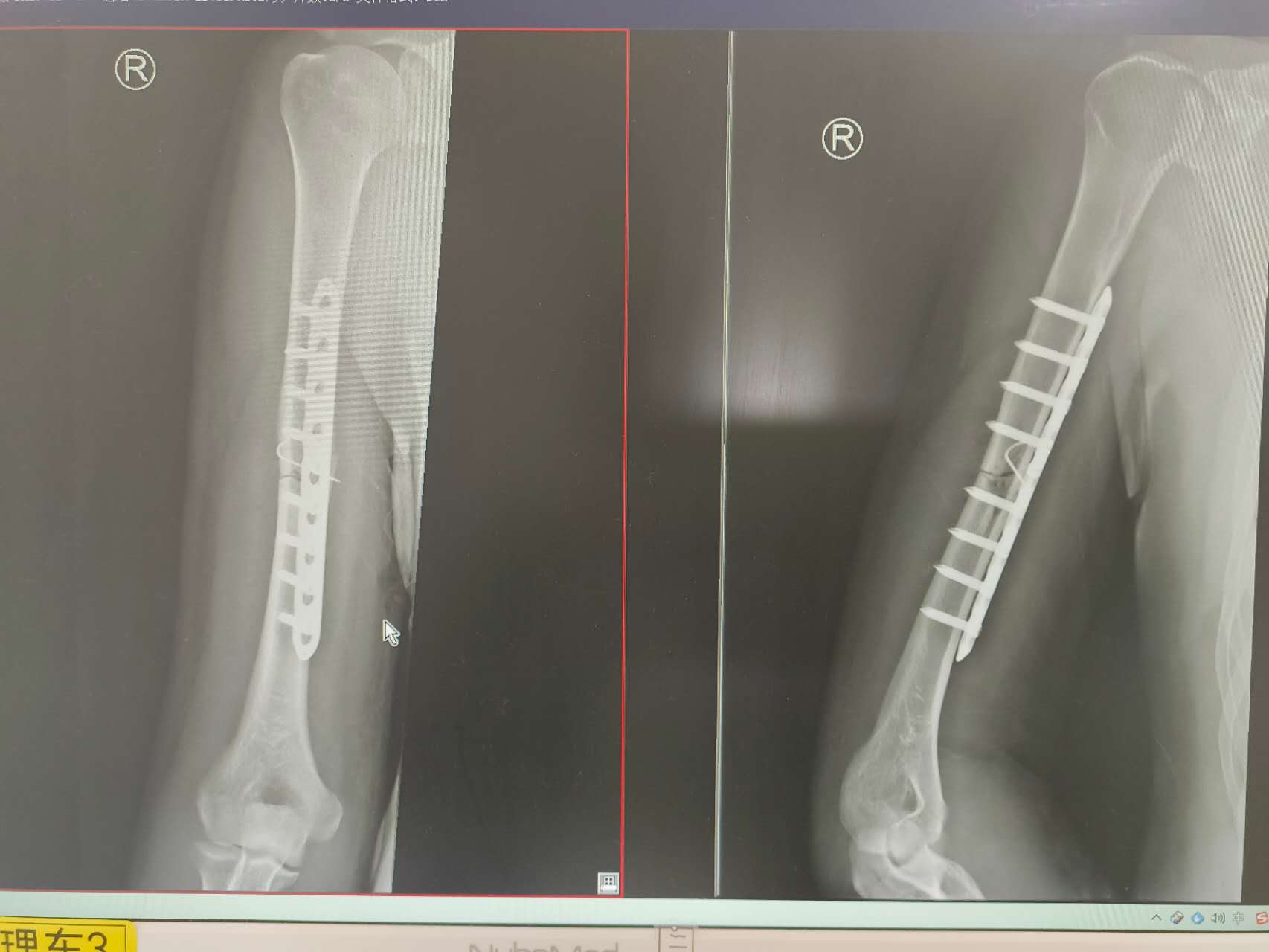
8 screws and an impressive (titanium?) rod makes me whole. I am told I can have another surgery in a year or so to remove the rod, but unless someone explains to me a medical reason why removing the rod is necessary, I see no reason to undo the first step of my transhuman evolution into wolverine.
Through all of this I was quite overcome by a sense of gratitude. A friend explained to me that there is a Chinese phrase for such situations: 不幸中的万幸 / bùxìng zhōng de wànxìng / Good luck in bad luck or “Bad luck, nonetheless, good luck.” In other words, I broke my arm, but:
I didn’t hit my head. I’d rather 100 broken arms than a concussion.
I wasn’t alone. My friend (who also slipped on the same spot) accompanied me to the hospital.
I got immediate help from the bao’an and the ambulance.
I didn’t break any joints.
I got the best possible healthcare in Shenzhen – a whole team of excellent doctors.
I didn’t break my arm in America. 5 days in the hospital, emergency transport, and surgery cost me a grand total of 13,000 yuan ($1,800). And it’s all 100% covered by my insurance. Strange fact: staying the night in the hospital is cheaper than most hotels in Shenzhen.
Within two days of surgery, I didn’t need the sling.
Within five days of surgery, I didn’t need to worry about pain medication.
Within two weeks of surgery, my stitches didn’t need a bandage.
bùxìng zhōng de wànxìng.
不幸中的万幸
I couldn’t be more grateful for how this all turned out. Can you imagine breaking your arm in half in a foreign country, with my poor language skills, with no family to contact, with no knowledge of how hospitals and healthcare work—and the outcome is this good? 好运 hǎo yùn. I wrote a thank you note to the fine doctors and nurses who saw me through this with clockwork professionalism and meticulous competence.
Happy three week anniversary to my broken arm!
Categories: Uncategorized
 Evander Price